
Agricultural Land Market for Legal Entities: Two-Year Results and Key Expectations for 2026
19.01.2026
Opening of the Land Market for Legal Entities: Two Years of Practice
On January 1, 2024, Ukraine entered a new stage of land reform, granting legal entities the right to purchase agricultural land with a limit of up to 10,000 hectares per entity. Despite wartime risks and economic instability, the market has gradually adapted to the new conditions and formed clear rules for businesses and investors.
As of early 2026, it is evident that opening the land market to legal entities did not cause major distortions but significantly influenced demand structure, pricing, and regional distribution of transactions.
Key Market Indicators: Number of Transactions and Price Dynamics
Since the launch of the land market, more than 339,000 land sale transactions have been concluded in Ukraine. Over the first four years, the average price per hectare increased by around 60%, exceeding UAH 60,000.
Compared to the initial phase of the reform in 2021, the number of transactions in 2025 grew steadily, while the total value of deals nearly tripled. This indicates a gradual restoration of confidence in the land market, even amid ongoing war.
How Legal Entities Have Changed Land Prices
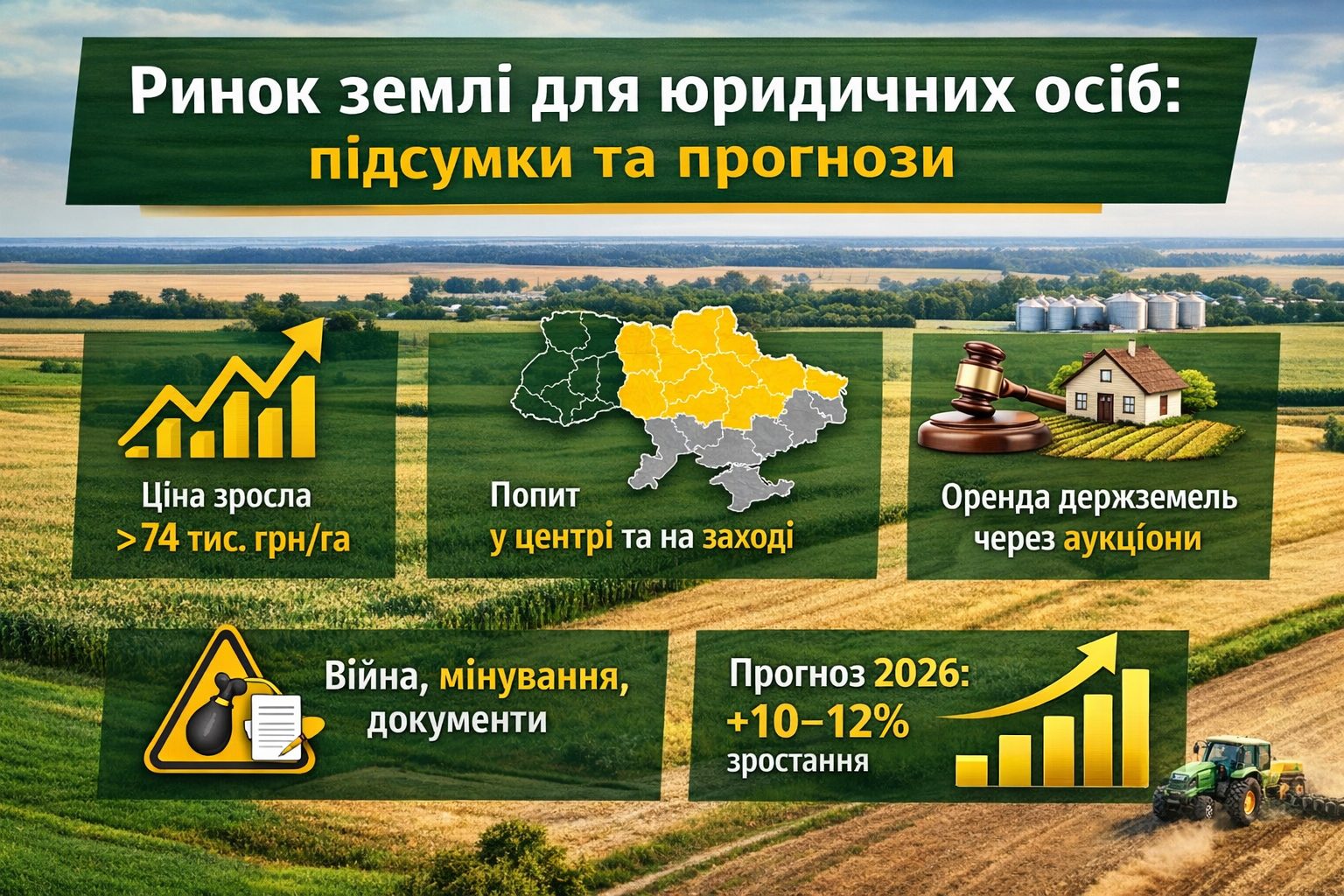
The entry of legal entities became one of the key drivers of price growth. While in 2023 the average land price ranged between UAH 37,000–40,000 per hectare, by the end of 2025 it exceeded UAH 74,000.
Unlike individual buyers, legal entities focus on acquiring large, contiguous land plots that enable operational efficiency. For such land banks, businesses are willing to pay 50–60% more than private buyers.
Regional Differences: Where Land Is the Most Expensive
The highest land prices are observed in central and western regions of Ukraine. These areas combine relatively high security levels, developed infrastructure, fertile soils, and stable demand from agribusinesses.
In contrast, frontline regions in the south and east remain restrained. High security risks, landmines, and logistical challenges significantly reduce investment attractiveness.
The Role of the State Land Bank and Leasing of State-Owned Land
An important element of land policy has been the introduction of the State Land Bank mechanism. It enables long-term leasing of state-owned land — up to 50 years — through transparent online auctions on the Prozorro.Sale platform.
This tool creates additional opportunities for farmers and agribusinesses that are not ready to purchase land but seek stable, long-term land use.
New Opportunities for Defenders of Ukraine
A social dimension of the reform is also emerging. Part of the land privatized during the restructuring of state-owned enterprises is allocated to special funds benefiting Ukraine’s defenders. This contributes to the formation of a new category of landowners and gradually reshapes the social structure of the market.
Land-Backed Lending: Progress and Limitations
Although the number of loans secured by agricultural land is gradually increasing, access to financing remains limited. High interest rates and strict banking requirements continue to restrain small and medium-sized agricultural producers.
On average, just over 200 land-backed loan agreements are concluded per month — far below the market’s full potential.
Market Challenges: War, Landmines, and Documentation Issues
Among the key challenges is the limited availability of land due to hostilities and contamination with landmines. According to expert estimates, about 20% of the potential land market is effectively excluded from circulation.
Additional difficulties include cadastral errors, unresolved inheritance issues, and delays in property rights registration, which were particularly noticeable in 2025.
Outlook for 2026: Development Scenarios
Analysts expect the land market to continue developing unevenly in 2026. If the security situation improves, demand may rise sharply, especially in central and western regions, triggering a new phase of price growth.
Under a more conservative scenario, land prices are expected to grow by 10–12% annually, still outperforming inflation and reinforcing land’s status as an attractive investment asset.
Who Is Buying Land Today: Investor Profiles
Key buyers include large farming enterprises securing strategically important plots, entrepreneurs with agricultural backgrounds, and investors viewing land as a long-term capital preservation tool.
A separate group consists of top managers of large agricultural holdings who, through affiliated structures, secure long-term control over production assets.
Trading of Lease Rights as a New Trend
Alongside land purchases, the market for land lease rights is developing rapidly. In some regions, the value of long-term lease rights reaches a significant share of the land’s market price, making this instrument a viable alternative to outright purchase.
Multiple Citizenship and the Impact of Foreign Capital
The legalization of multiple citizenship opens additional channels for capital inflow. Individuals holding Ukrainian citizenship along with foreign citizenship can legally purchase land within established limits, potentially increasing competition and supporting further price growth.
Land as a Strategic Long-Term Asset
In summary, the agricultural land market for legal entities is gradually moving from the adaptation phase to strategic development. Land is increasingly perceived not only as a production resource but also as a long-term asset capable of preserving and increasing value even under challenging economic conditions.